
Global Central Bank Policy Rates

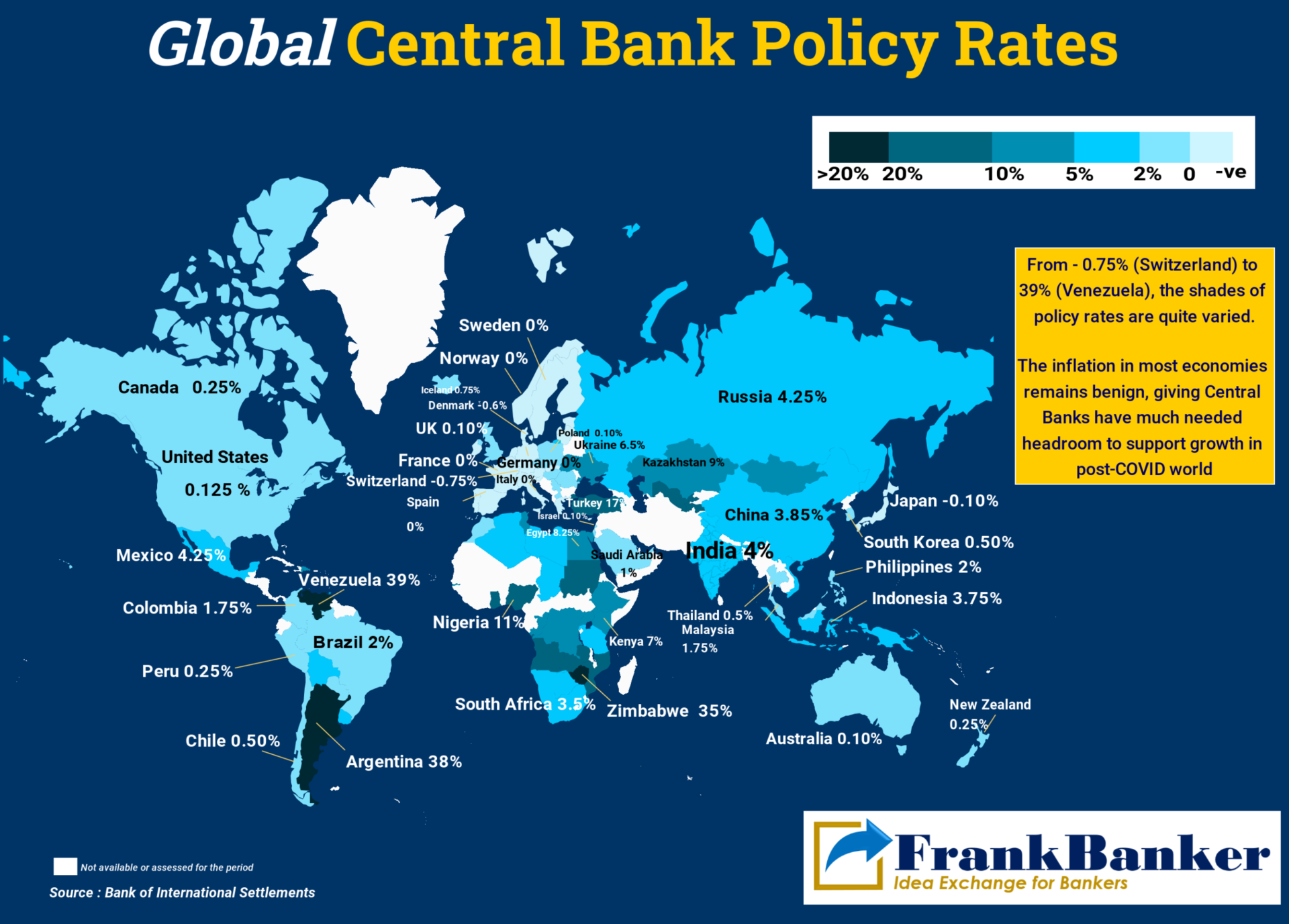
[dropcap]F[/dropcap]rom – 0.75% (Switzerland) to almost Zero in most of Europe to around 4% in India, Central Banks in most economies remain accommodative. 
Although inflation remains benign in most places, some high inflation economies like Argentina (38%) and Venezuela (39%),  have their plates overflowing with challenges.
While the GDP projections are encouraging, whether cheaper credit can fuel a rebound in economic activity, remains to be seen.
We at FrankBanker are hopeful!
[btn url=”https://www.frankbanker.com/wp-content/uploads/2021/03/Global-Central-Bank-Policy-Rates-1.pdf” text_color=”#000000″ bg_color=”#daa520″ icon=”” icon_position=”start” size=”14″ id=”” target=””]Download and Share[/btn]

Disclaimer: The opinions expressed here are those of the author and do not reflect the views of FrankBanker.com

Related Essays

  • | |

    India’s DPI Stack: A Banker’s Guide

    India’s DPI story is often told through scale. This guide looks at it through structure. It maps the digital rails, protocols, access layers, and public data systems that increasingly shape lending, onboarding, verification, payments, and underwriting in India. From Aadhaar, UPI, DigiLocker, and Account Aggregator to OCEN, ONDC, ULI, and the expanding universe of public data APIs, the guide explains what each layer does, where it fits, and where the gaps still remain.

  • RBI Monetary Policy Instruments: A Banker’s Guide

    The RBI’s monetary policy toolkit is wider than most practitioners realise. The repo rate gets the headlines, but the real work happens across the LAF corridor, the SDF floor, the CRR and SLR requirements, and the structural tools like OMO and forex swaps. This guide maps all of them. Starting from RBI definitions to what each instrument actually does.

  • Banking on SPAM?

    In a recent survey we found 86% of participants reported Banks and FIs to be the biggest spammers. Banks need to realise that every interaction with customers, existing or potential, is a moment of truth. Pestering only leads to increased trust deficit as the customer starts to see an ‘aggressive marketer’ and not a ‘trusted partner’