
Unlocking India’s Credit Potential: A Comparative Look at OCEN and ULI

comparison of OCEN and ULI

India’s journey towards financial inclusion is being revolutionized by two pivotal initiatives in its Digital Public Infrastructure (DPI): the Open Credit Enablement Network (OCEN) and the Unified Lending Interface (ULI). These platforms are designed to transform the lending landscape by making credit more accessible and streamlined for underserved segments. But how do they differ, and what unique roles do they play in enhancing India’s digital credit ecosystem?

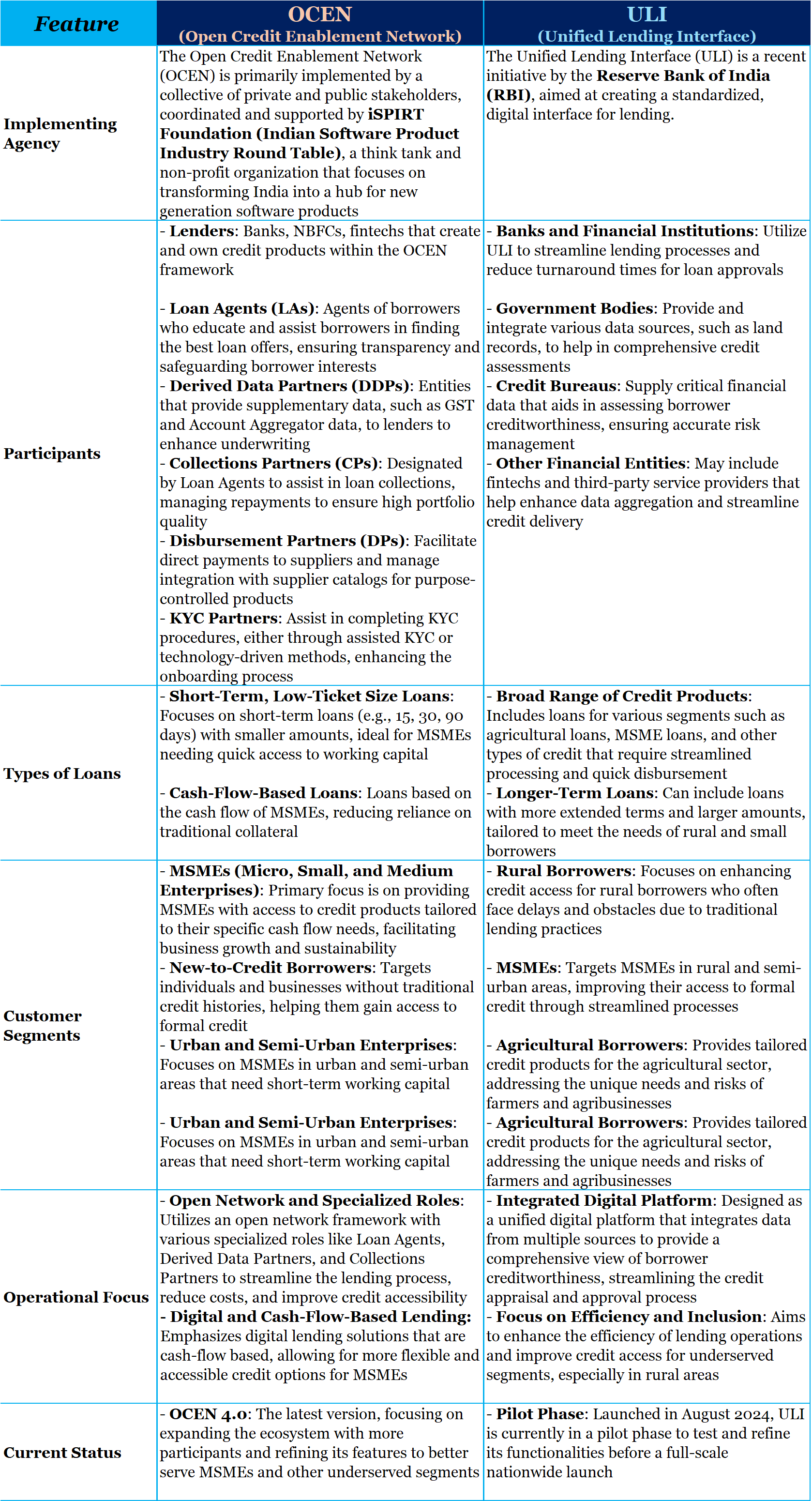
The table below breaks down their key features and objectives
OCEN and ULI comparison

OCEN and ULI represent a dual approach to leveraging digital technology for financial empowerment in India. While each platform targets different aspects of the credit delivery process, together, they embody the future of inclusive finance. While details are still evolving, we are excited that by addressing the needs of diverse borrower segments, these initiatives are not just reshaping credit access—they are redefining what it means to participate in the digital economy.

Disclaimer: The opinions expressed here are those of the author and do not reflect the views of FrankBanker.com

Related Essays

  • RBI Monetary Policy Instruments: A Banker’s Guide

    The RBI’s monetary policy toolkit is wider than most practitioners realise. The repo rate gets the headlines, but the real work happens across the LAF corridor, the SDF floor, the CRR and SLR requirements, and the structural tools like OMO and forex swaps. This guide maps all of them — definitions from RBI’s own language, current rates as of February 2026, and what each instrument actually does to liquidity.

  • Credit Risk Blindspots: Hidden Biases in Lending

    Bias is an inherent human tendency, and recognising and minimising it requires deliberate effort. No matter how advanced the financial models or how experienced the analysts, Credit Risk decisions are inevitably influenced by personal experiences and context. The challenge lies in identifying when this reliance on past-experience crosses the line into bias.

  • SME Lending Channel Strategy: Key Success Factors

    Lenders—Banks, NBFCs, or FinTechs—face the classic ‘Knapsack Problem’ while trying to create an optimal SME lending distribution structure. Each channel mix—branches, digital, phygital, own, agents, co-lending—brings its own costs and benefits, with varying considerations of scale, risk appetite, resources, and practicality specific to each lender. These essential considerations can help bring clarity to your distribution strategy.

  • Designing Loan Products: A ‘First Principles Thinking’ Blueprint

    In Banking, there are no barriers to imitation. Any lender—Bank, NBFC, or Fintech—can easily build a Loan product suite simply by following the leader. This quick-fix works until the inevitable product and portfolio challenges arise. However, for long-term sustainability, you need to innovate, differentiate, and pioneer new approaches while managing risk well. First Principles Thinking is exactly what works here