
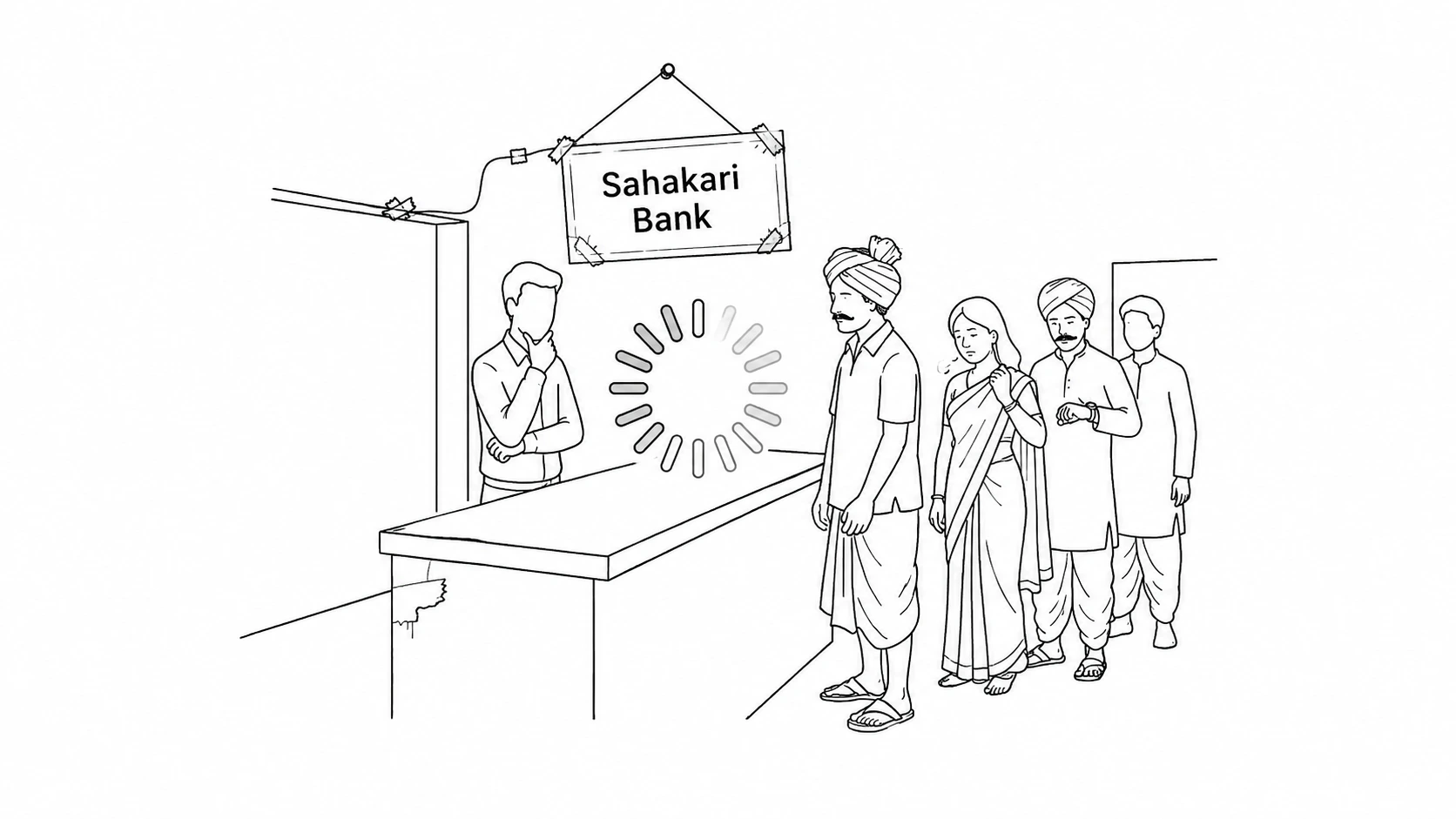
A Sector at a Crossroads
Ask most people in Indian finance to name the country’s largest category of banks by number, and they will guess wrong. The answer is Cooperative Banks — nearly 1,843 supervised entities, including Rural Cooperative Banks (RCB) like DCCBs, StCBs and Urban Cooperative Banks (UCB) [1]most of them serving the farmers, traders, artisans, small businesses, salaried middle class and marginal households of urban and semi-urban India that commercial banks have consistently overlooked. Of these, 1,457 UCBs alone hold ₹5.84 lakh crore in deposits and ₹3.70 lakh crore in advances. [1] Beyond the numbers, the cooperative banking sector is far larger in grassroots impact and highly consequential to the communities it serves.
Part of what makes UCBs different and somewhat complex is that they wear two hats. Each UCB is, at its foundation, a Cooperative Society — owned by its members, registered under state cooperative laws such as the Karnataka Souharda Sahakari Act, 1997 or the Multi-State Cooperative Societies Act, 2002, and governed on cooperative principles of democratic participation. [2] Layered on top is the banking function, regulated by RBI under the Banking Regulation Act, 1949. The cooperative society and the bank live inside the same institution, answerable to different regulators for different aspects of their existence.
The 2020 amendment to the BR Act strengthened RBI’s supervision over UCBs — with powers to regulate, intervene in management, audit books, and supersede boards. The regulatory heat has been rising steadily ever since. A four-tier classification framework in 2022,[3] a Prompt Corrective Action framework effective April 2025,[4] and new Business Authorisation criteria finalised in December 2025[5] have all raised the bar on capital, governance, and compliance. RBI’s enforcement posture has matched the rhetoric — ₹29.15 crore in penalties on 118 cooperative banks in just six months between December 2024 and May 2025. The number of UCBs declined steadily from 1,926 at end-March 2004 to 1,457 at end-March 2025[1]
While this has reduced regulatory ambiguity, the underlying tension between cooperative culture and banking compliance has not. Meeting these new regulatory demands requires infrastructure, improved risk frameworks, enhancement in compliance capabilities that most UCBs neither have nor can easily afford. Technology often gets cited as the panacea and the blame is put on UCBs for being misaligned to digital age.
If Lending Fintechs Can Why Can’t UCBs?
It is easy to blame it on UCBs especially considering the kind of technology leverage new age lending Fintechs have shown. They originate loans in minutes using GST filings, UPI transaction analytics, and Bank statement data. Despite the cost of funds disadvantage these Fintechs are competing on speed, data, and experience. If nimble new entrants can do it, why can’t institutions with decades of community trust and a captive member base?
This is seemingly superficial comparative. A UCBs cooperative identity, community embeddedness and ability to reach grassroots are genuine advantages that digital-first lenders cannot replicate. The right response is to modernise the systems through which those advantages are expressed and not diluted.
What rarely gets asked is whether the technology on offer was ever built for an institution like this. There is, however, an equally uncomfortable question on the other side: what UCBs consider digitisation to be- and whether that belief is part of the problem.
CBS Is Not a Technology Strategy
Ask a Cooperative bank if it has technology and the answer is almost always yes. Virtually every UCB today operates on CBS, driven by 2016 mandate by RBI. [7] Dig deeper- ask for a live portfolio stress report, a digital loan origination workflow, or a structured view of member relationships- and suddenly, the gaps appear. CBS availability gets cited as evidence of digital readiness. It is not. By 2024-25, RBI’s own supervisory agenda had moved well past CBS adoption with focus on cyber resilience, ITSPs, card management, and mobile banking, treating CBS as an assumed baseline rather than a milestone.
A CBS is built for one job: record-keeping at scale. It manages accounts, processes transactions, and maintains the general ledger- reliably, at volume, across branches. What it was never designed to do is to manage workflow stages, hierarchical approvals, or credit logic. It cannot assess a loan application, flag a borrower sliding toward default, or tell a relationship manager which member hasn’t been contacted in six months. These are the daily operational reality of a lending institution. The full stack a modern lender actually needs has five layers:
- CBS — for transaction processing, core accounts, and ledger management
- Loan Origination System (LOS) — for application processing with embedded digital validation, credit assessment, and vertical and horizontal workflows
- Loan Management System (LMS) — for complex loan management, post-disbursement monitoring, and NPA early warning
- CRM — for lead management, structured member relationship management, and channel tracking
- Analytics and reporting– for regulatory and business intelligence. Partially embedded in CBS, much of it is still collated in excel sheets
Most UCBs have only the first and make do with the rest. Without an LOS, loans are originated on paper with no audit trail. Without an LMS, customer service suffers and portfolio stress goes untracked until it is too late. Without a CRM, there is no systematic visibility into members, leads, or channels — the very relationship intelligence that cooperative banks claim as their edge over commercial lenders. In practice, all of this gets improvised inside the CBS.
The CBS becomes a catch-all: transaction engine, accounts and loan tracker, relationship record, compliance tool, and collection tracking- asked to do everything it was never designed to do. And what it actually delivers often depends less on what the bank needs than on what the CBS vendor chose to provide years back!
One Size Fits Nobody
The UCB sector’s heterogeneity is extreme. A Tier 4 multi state UCB with ₹15,000 crore in deposits [3] has fundamentally different complexity from a single-district Tier 1 bank with ₹80 crore in deposits — different product mixes, member demographics, branch footprints, lending patterns, regulatory obligations, and state-specific cooperative legislation. [2]
This fragmentation destroys the economics of standardised solutions: no single product specification serves the full range of 1,400-plus institutions. A smaller cooperative bank does not need a wide, feature-rich system. A larger one cannot function with a narrow point solution. This is compounded by the twin constraints most cooperatives face: limited internal technology capability and limited technology affordability.
To resolve this, umbrella bodies such as NAFCUB and NUCFDC have instinctively tried to centralise technology arrangements. [8] This is well-intentioned but runs into the same heterogeneity problem. Centralised vendor empanelment assumes a shortlisted set of approved platforms can serve institutions spanning Tier 1 small banks to Tier 4 large multi-product institutions with treasury operations.
No single vendor adequately serves both ends. Either smaller banks pay for product width they cannot use- falling into the integration trap- or mid-size and larger banks end up with narrow point solutions, ultimately sliding into the customisation trap, where every loan product parameter, every workflow step, every report format becomes a billable Customisation Request (CR). As cost of ownership escalates, banks stop asking for what they need. And slowly, quietly, make peace with dated systems. Over time, Excel sheets take over.
Trapped by Design: Both Banks and Vendors
The technology market appears competitive – multiple vendors, broadly similar feature sets, giving an impression of the stack, and particularly CBS, being commoditised.
Larger technology players respond to UCBs’ cost constraints with off-the-shelf configurations — standardised products built for standardised institutions. Smaller vendors go the other way, offering cut-throat pricing to win mandates they cannot sustain. Neither model works. One delivers a product the bank must shrink itself to fit. The other delivers a vendor that quietly runs out of runway.
In both cases, the outcome converges: patchy support, slow feature upgrades, and slower updates to accommodate regulatory changes.
Switching is not a real option for cooperatives. Migrations are expensive, operationally disruptive, and carry significant data risk- especially for institutions with limited technical bandwidth. The bank is left with a system that becomes progressively more dated and, over time, unable to support dynamic regulatory and market requirements.
The underlying cause is structural: Banking Technology is calibrated for large commercial institutions – large upfront budgets, multi-year horizons, dedicated project teams, sophisticated internal stakeholders. Once cooperative sector realities strip those assumptions away, implementations routinely overrun on time and cost, under-deliver on functionality, and produce shadow workarounds that undermine the efficiency gains technology was supposed to deliver.
The vendors, for their part, are prisoners of their own architecture — locked into waterfall timelines, siloed development cycles, and a delivery model that was never designed for the structures cooperative banks actually need.
A Different Architecture Is Possible
The sector’s technology failure is not inevitable. It is the consequence of applying the wrong architectural and commercial model to the wrong type of institution and then repeating that mistake across decades.
The core shift is unbundling what has been wrongly packaged together. A production-ready foundational layer- CBS, Regulatory compliance, integration readiness- should be separable from modular Payments, Analytics, LOS, LMS and CRM components that institutions adopt as their scale and complexity justify. No forced bundling. No paying for product width that will never be used. Also, no force fitting into CBS.
Architecture must be Configuration-First. Loan product structures, interest methodologies, member categories, workflow approvals, BRE logic, and RBI and state-specific regulatory submissions should be adjustable through administrative settings – not routed through a CR queue and a sprint cycle. If a parameter change or product addition requires a vendor ticket, the architecture has already failed.
Deployment cannot be a binary choice. Institutions with smaller scale can benefit from multi-tenant SaaS economics while scaled up UCBs need on-premise options. A platform built for this sector must offer both- not as an afterthought, but as a design principle.
Umbrella organisations like NAFCUB and NUCFDC have a clearer role than they currently play: standards-setting, compliance scaffolding, and ecosystem stewardship- not vendor procurement. They need to work on creating an ecosystem for technology innovation by supporting innovation and the economic viability of new-age technology players, rather than attempting to become technology recommenders themselves.
For vendors, sustainable unit economics must be calculated from day one, not deferred to a hoped-for future scale. The current model, where implementation is underpriced to win the deal and services revenue is expected to compensate over time, is precisely what produces the CR trap.
New-age technology startups, unburdened by legacy codebases and tech stack orthodoxy, can break this cycle. They can build configuration-first, deploy fast, and honestly priced solution The technology exists. The architectural thinking exists. What has been missing is a builder willing to apply both to an institution type that has been underserved for too long. That is beginning to change.
Key Data at a Glance
| SECTOR OVERVIEW | |
| Total supervised cooperative banks (March 2025) | ~1,843 (1,457 UCBs under RBI + 34 StCBs + 351 DCCBs + 1 industrial co-op bank under NABARD) [1] |
| UCB deposits / advances | ₹5.84 lakh crore / ₹3.70 lakh crore | Credit-deposit ratio: 63.3% [1] |
| UCB share of banking sector | ~3–4% of total deposits and advances [1] |
| FINANCIAL HEALTH — UCBs (March 2025) | |
| Aggregate CRAR | 18.0% (regulatory minimum: 12% for Tier 2–4) [1,6] |
| Gross NPA / Net NPA | 6.1% / 0.6% — 4th consecutive year of improvement (was 8.8% gross NPA in March 2024) [1,6] |
| Net profit growth | 14.2% in FY25 (following 52% in FY24) [1] |
| REGULATORY FRAMEWORK | |
| Four-tier classification | December 2022 | Tier 1: ≤₹100 cr | Tier 2: ₹100–1,000 cr | Tier 3: ₹1,000–10,000 cr | Tier 4: >₹10,000 cr [3] |
| Prompt Corrective Action (PCA) | Effective April 1, 2025 — replaces Supervisory Action Framework | Applies to Tier 2–4 [4] |
| ECBA — Business Authorisation | December 2025 — requires net NPA ≤3% + net profit for 2 consecutive years [5] |
| RBI enforcement (Dec 2024 – May 2025) | ₹29.15 crore in penalties on 118 cooperative banks |
| PSL target | 65% in FY25 → 75% by March 2026 [1] |
| TECHNOLOGY SNAPSHOT | |
| CBS penetration | >90% of UCBs (but CBS alone ≠ technology-enabled) [7] |
| Full stack — LOS + LMS + CRM | Adoption critically low | Most UCBs have CBS only [7] |
| Account Aggregator (AA) readiness | Very limited — most UCBs not yet active as FIP or FIU [7] |
Notes :
- UCBs rely predominantly on deposits for funding, with borrowings accounting for only 0.8 per cent of total liabilities at end-March 2025. trends
- The capital position of UCBs continued to strengthen in the post-pandemic period, with their CRAR rising to 18.0 per cent in March 2025. The capital position of UCBs continued to strengthen in the post-pandemic period, with their CRAR rising to 18.0 per cent in March 2025.
References
| # | Source / Description |
| 1 | RBI — Report on Trend and Progress of Banking in India 2024-25 (Press Release, December 2025) https://www.rbi.org.in/Scripts/BS_PressReleaseDisplay.aspx?prid=61902 |
| 2 | RBI Urban Banks Department — Regulation and Supervision of Primary (Urban) Cooperative Banks: Overview [PDF] https://rbidocs.rbi.org.in/rdocs/Publications/PDFs/89735.pdf |
| 3 | RBI Notification RBI/2022-23/144, DOR.REG.No.84/07.01.000/2022-23 — Revised Regulatory Framework: Categorisation of Urban Co-operative Banks (UCBs) for Regulatory Purposes, December 1, 2022 https://rbi.org.in/Scripts/NotificationUser.aspx?Id=12416&Mode=0 |
| 4 | RBI Notification RBI/2024-25/55, DOS.CO.PPG.SEC.No.8/11.01.005/2024-25 — Prompt Corrective Action (PCA) Framework for Primary (Urban) Co-operative Banks, July 26, 2024 (effective April 1, 2025) https://rbi.org.in/Scripts/NotificationUser.aspx?Id=12711&Mode=0 |
| 5 | RBI — Master Direction on Expanded Co-operative Banking Authorisation (ECBA) / Entry of New UCBs and Business Authorisation for Existing UCBs, December 2025 https://www.rbi.org.in/Scripts/BS_PressReleaseDisplay.aspx?prid=61050 |
| 6 | RBI — Financial Stability Report, June 2025 [PDF] https://rbidocs.rbi.org.in/rdocs/PublicationReport/Pdfs/0FSRJUNE20253006258AE798B4484642AD861CC35BC2CB3D8E.PDF |
| 7 | RBI — Annual Report 2024-25 https://rbi.org.in/Scripts/AnnualReportMainDisplay.aspx |
| 8 | NAFCUB — CBS Vendor Empanelment Initiative https://nafcub.org/cbs-initiative.php |
