
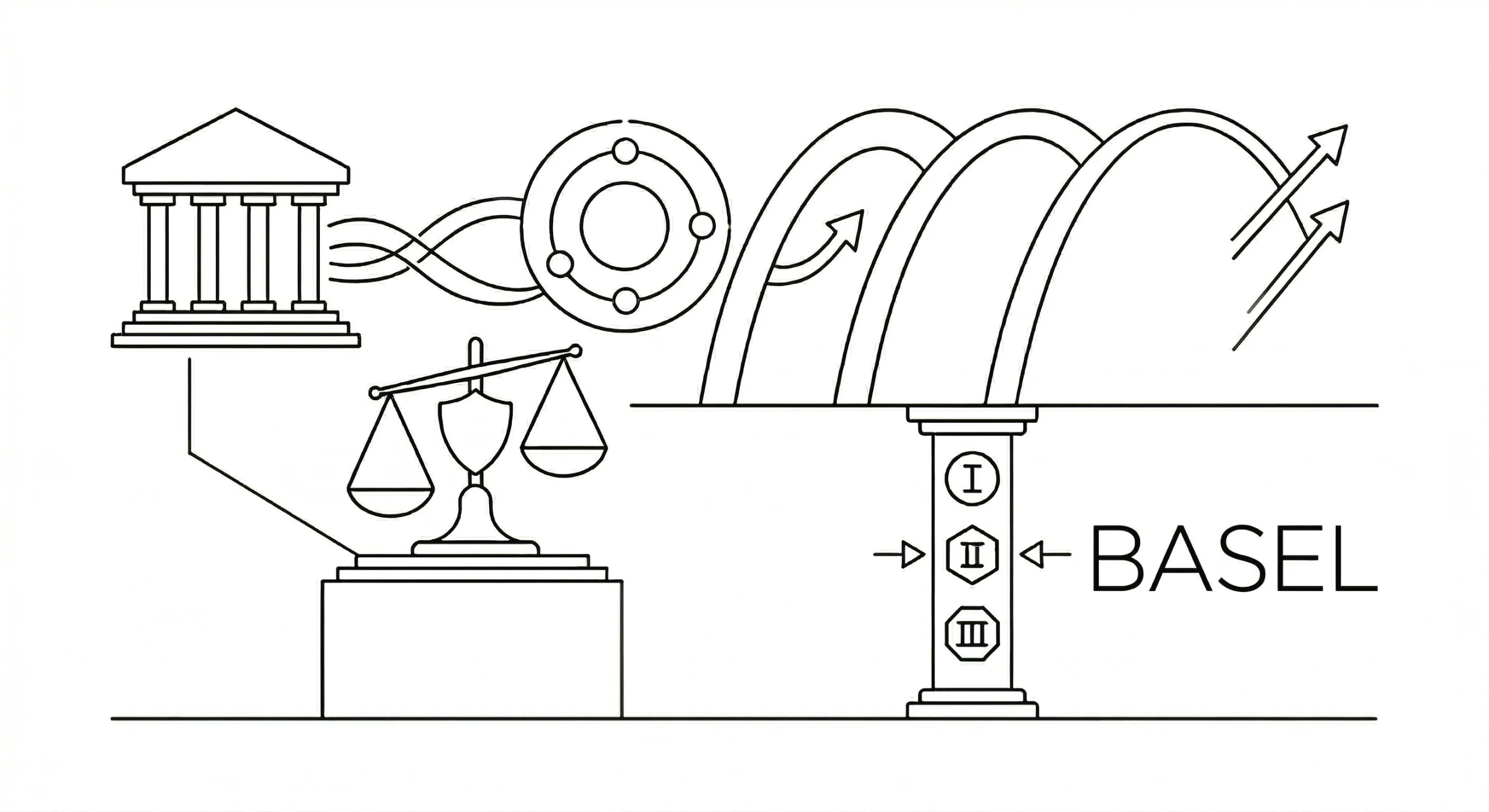
WHAT ARE BASEL NORMS
Basel norms are international capital and risk standards issued by the Basel Committee on Banking Supervision (BCBS), a body housed at the Bank for International Settlements (BIS) in Basel, Switzerland. They set the minimum capital a bank must hold against its risk-weighted assets, the liquidity it must maintain, and the leverage it is permitted to take. Three successive frameworks, Basel I (1988), Basel II (2004), and Basel III (2010, revised 2017), have progressively raised the quality and quantity of capital banks must hold. In India, the RBI implements Basel norms for all scheduled commercial banks through its Master Circular on Basel III Capital Regulations (April 2024) and related directions.
QUICK REFERENCE: KEY RATIOS AND THRESHOLDS
For the reader who needs the number immediately.
| Metric | BCBS Minimum | RBI Requirement (India) |
| CET1 Ratio | 4.5% of RWA | 5.5% of RWA |
| Tier 1 Capital Ratio | 6.0% of RWA | 7.0% of RWA |
| Total CRAR (Tier 1 + Tier 2) | 8.0% of RWA | 9.0% of RWA |
| Capital Conservation Buffer (CCB) | 2.5% of RWA (CET1) | 2.5% of RWA (CET1) |
| Total CRAR incl. CCB | 10.5% | 11.5% |
| Countercyclical Buffer (CCyB) | 0–2.5% (national regulator) | Not currently activated |
| Leverage Ratio | 3.0% | 4.0% D-SIBs; 3.5% others |
| Liquidity Coverage Ratio (LCR) | 100% | 100% |
| Net Stable Funding Ratio (NSFR) | 100% | 100% |
| D-SIB Additional CET1 Surcharge | — | 0.2%–0.8% by bucket |
Source: BCBS Basel III framework (BIS, 2010/2017); RBI Master Circular on Basel III Capital Regulations (April 2024)
HOW TO USE THIS GUIDE
Part A covers the foundations: the evolution from Basel I to Basel III, the three-pillar structure, and the key capital and liquidity concepts. If you are building your understanding from scratch or need a structured refresher, Part A will suffice.
Part B goes deeper: how each risk type is measured, the approaches available to banks, and an honest assessment of what Basel III does not address. It is written for practitioners who work with these frameworks operationally.
The India section consolidates what all of this means specifically for Indian banks and NBFCs, with RBI’s specific calibration of Basel requirements and D-SIB implications.
Estimated reading time: Part A: 15 minutes. Part B: 20 minutes.
PART A: FOUNDATIONS
1. Why Basel Norms Exist
Banking crises are expensive for depositors, governments, and economies. The fundamental problem is that banks take deposits from millions of people and lend them out over long periods at higher risk. When those loans go bad, the losses can exceed the bank’s own capital, leaving depositors unprotected and requiring government bailouts.
Basel norms exist to ensure that banks hold enough of their own capital as a cushion between bad loans and depositor losses. The logic is simple: the more capital a bank holds, the more losses it can absorb before it becomes insolvent. The complexity lies in defining what counts as capital and how much is enough.
The BCBS was established in 1974 following the failure of Bankhaus Herstatt, a German bank whose collapse exposed dangerous gaps in cross-border banking regulation. It now includes regulatory authorities from 28 jurisdictions covering the world’s major banking systems.
2. Basel I (1988): The First Attempt
Basel I made a single, consequential contribution: it established that a bank’s required capital should be linked to the riskiness of its assets, not just their absolute size. The vehicle was the Risk-Weighted Asset (RWA), which adjusts each asset by a risk weight reflecting its likelihood of default.
Under Basel I, assets were bucketed into four risk weights:
| Risk Weight | Asset Type (Basel I) | Examples |
| 0% | Sovereign / Central Bank | Government securities, central bank claims |
| 20% | OECD bank / multilateral | Claims on OECD banks, multilateral institutions |
| 50% | Residential mortgage | Residential mortgages |
| 100% | Corporate / other | Corporate loans, consumer credit, all others |
The minimum Capital Adequacy Ratio (CAR) was set at 8% of RWA. Banks had to hold at least 8 rupees of capital for every 100 rupees of risk-weighted assets.
Basel I covered only credit risk and used blunt risk weights with no differentiation within each bucket. A loan to AAA-rated Infosys carried the same 100% risk weight as a loan to a distressed SME. This was its primary limitation, alongside its complete silence on market risk and operational risk.
3. Basel II (2004): More Risk Sensitivity, Three Pillars
Basel II retained the 8% minimum CRAR but fundamentally changed how risks were measured and introduced a governance structure around capital adequacy. Its defining contribution was the Three-Pillar framework, which remains the architecture of all subsequent Basel norms.
Pillar 1: Minimum Capital Requirements
Basel II expanded the scope of capital requirements to cover three risk categories:
Credit Risk: refined from Basel I’s four risk buckets into two approaches:
- Standardised Approach: Uses external credit ratings to assign risk weights. More granular than Basel I but still externally dependent.
- Internal Ratings-Based (IRB) Approach: Allows larger banks to use their own internal models to estimate credit risk, subject to regulatory approval. Foundation IRB uses bank-estimated probability of default with regulatory inputs. Advanced IRB allows full internal estimation.
Market Risk: capital charge for losses arising from changes in interest rates, equity prices, foreign exchange rates, and commodity prices. Measured using Value-at-Risk (VaR) models at 99% confidence over a 10-day holding period.
Operational Risk: new in Basel II. Capital charge for losses from inadequate processes, people, systems, or external events. Three approaches available: Basic Indicator Approach (BIA), Standardised Approach (TSA), and Advanced Measurement Approach (AMA).
Pillar 2: Supervisory Review
Pillar 2 introduced the requirement that banks conduct an internal assessment of their own capital adequacy against all risks, including those not covered in Pillar 1 (interest rate risk in the banking book, concentration risk, reputational risk). This is the Internal Capital Adequacy Assessment Process (ICAAP).
Regulators respond with a Supervisory Review and Evaluation Process (SREP), which can impose additional capital requirements above the Pillar 1 minimum if a bank’s risk profile warrants it.
Pillar 3: Market Discipline
Pillar 3 requires banks to disclose detailed information on their capital adequacy, risk exposures, and risk management processes. The logic: informed market participants (investors, analysts, counterparties) impose additional discipline on banks through their pricing of debt and equity, supplementing formal regulation.
4. Basel III (2010, Revised 2017): Responding to the Global Financial Crisis
The 2008 Global Financial Crisis revealed that Basel II’s capital requirements were insufficient in both quantity and quality. Banks that appeared well-capitalised on paper were unable to absorb losses without government intervention. Basel III addressed this through reforms in six areas.
4.1 Capital Quality: The Rise of CET1
The most consequential change in Basel III was the sharp focus on Common Equity Tier 1 (CET1), which is the highest quality of capital, comprising ordinary shares and retained earnings. CET1 absorbs losses immediately and without any obligation to repay.
Basel III redefined the capital hierarchy:
| Capital Tier | What It Includes | Loss Absorption |
| CET1 | Ordinary shares, retained earnings, disclosed reserves | Going concern. Absorbs losses while bank continues operating |
| Additional Tier 1 (AT1) | Perpetual instruments, contingent convertibles (CoCos) | Going concern. Lower quality than CET1 |
| Tier 2 | Subordinated debt, revaluation reserves (at discount) | Gone concern. Absorbs losses in liquidation |
CET1 minimum was raised to 4.5% of RWA (from an effective 2% under Basel II). Total Tier 1 minimum was set at 6%, requiring that AT1 instruments fund no more than 1.5% of the 6%.
4.2 Capital Buffers
Beyond the minimums, Basel III introduced two capital buffers, both to be met exclusively with CET1:
Capital Conservation Buffer (CCB): 2.5% of RWA held above the minimum in normal times. As a bank’s CET1 falls below the combined 7% (4.5% + 2.5%), restrictions on dividends, share buybacks, and discretionary bonuses are progressively imposed. This creates a powerful incentive to maintain the buffer.
Countercyclical Capital Buffer (CCyB): 0–2.5% of RWA, activated by national regulators when they observe excessive credit growth. The CCyB is a macro-prudential tool: it raises the cost of lending during boom cycles and releases capital during downturns when it is most needed. With both buffers fully activated, the effective CET1 requirement reaches 9.5% of RWA.
4.3 Leverage Ratio
Basel III introduced a non-risk-weighted leverage ratio as a backstop to the risk-based capital framework. Defined as Tier 1 capital divided by total exposure (on and off-balance sheet), the minimum is 3%.
The leverage ratio addresses a structural weakness in risk-weighted frameworks: banks can game RWA by holding assets that appear low-risk under the models but carry substantial actual risk. The leverage ratio imposes an absolute floor regardless of how assets are classified. More simply: a bank must hold at least 3 rupees of Tier 1 capital for every 100 rupees of total exposure, irrespective of risk weights.
4.4 Liquidity Requirements: LCR and NSFR
For the first time, Basel III introduced international minimum liquidity standards. Pre-2008, capital adequacy was the primary regulatory lens. Liquidity was assumed to follow. The crisis proved this wrong: banks collapsed not from insolvency but from liquidity failures when short-term funding dried up overnight.
Liquidity Coverage Ratio (LCR): Banks must hold enough High Quality Liquid Assets (HQLA), principally cash, central bank reserves, and government securities, to cover expected net cash outflows over a 30-day stress scenario. Minimum LCR = 100%. Under RBI guidelines, retail deposits carry a 5% run-off assumption while corporate deposits carry 40%, reflecting their different stability under stress.
Net Stable Funding Ratio (NSFR): Designed for structural resilience over one year. Available Stable Funding (ASF) must equal or exceed Required Stable Funding (RSF). Minimum NSFR = 100%. The ratio forces banks to fund long-term assets with stable long-term liabilities rather than short-term wholesale funding.
4.5 Systemically Important Banks: G-SIBs and D-SIBs
Basel III introduced additional requirements for banks whose failure could destabilise the financial system:
G-SIBs (Global Systemically Important Banks): Required to hold additional CET1 surcharge ranging from 1.0% to 3.5% depending on their BCBS-assessed systemic importance bucket. Current examples: JPMorgan Chase (US), ICBC (China), HSBC (UK).
D-SIBs (Domestic Systemically Important Banks): National regulators designate D-SIBs based on domestic systemic importance. In India, RBI currently designates three banks as D-SIBs: State Bank of India (SBI), HDFC Bank, and ICICI Bank, categorised into buckets with additional CET1 requirements of 0.2% to 0.8%.
Note: Hover over the text in above graphic to see the explanation of each term
PART B: DEEPER DIVE
5. Measuring Capital Requirements: How the Numbers Work
5.1 Credit Risk RWA: An Illustrative Example
The practical calculation: each asset is multiplied by its risk weight to arrive at its contribution to RWA.
| Asset | Book Value (₹ Cr) | Risk Weight | Risk-Weighted Value (₹ Cr) |
| Central government securities | 200 | 0% | 0 |
| Claims on banks (short-term) | 100 | 20% | 20 |
| Residential mortgages | 150 | 50% | 75 |
| Corporate loans (rated) | 300 | 100% | 300 |
| SME loans (unrated) | 100 | 100% | 100 |
| Total | 850 | — | 495 |
Capital required at 9% CRAR = ₹495 × 9% = ₹44.55 crore
Under the IRB approach, banks estimate their own risk parameters (probability of default, loss given default, and exposure at default) to calculate more precise RWA. This typically reduces RWA for high-quality portfolios but requires sophisticated data infrastructure and regulatory approval.
5.2 Market Risk Capital Charge
Market risk capital applies to positions in the trading book: assets held for active trading, classified as Held for Trading (HFT) or Available for Sale (AFS). The capital charge has two components:
Specific Charge: Covers issuer-specific risk, specifically the risk that a particular security moves adversely due to factors specific to that issuer. Applied to each security individually.
General Market Risk Charge: Covers systematic market risk across interest rates, equity prices, forex, and commodities. Applied using the standardised duration method for interest rate risk, or scenario-based approaches for equity and forex.
From April 2024, RBI updated the definition of the trading book for capital adequacy purposes in line with the BCBS Fundamental Review of the Trading Book (FRTB), mandating a more precise boundary between trading book and banking book to prevent regulatory arbitrage.
5.3 Operational Risk: Three Approaches
| Approach | Who Uses It | How It Works |
| Basic Indicator Approach (BIA) | Smaller banks | 15% of average annual gross income over 3 years |
| Standardised Approach (TSA) | Mid-sized banks | 12–18% applied to gross income by business line |
| Advanced Measurement Approach (AMA) | Large sophisticated banks | Internal models using loss data, scenario analysis, business environment factors |
The RBI issued the Master Direction on Minimum Capital Requirements for Operational Risk in June 2023, updating the operational risk framework for Indian banks. Most Indian banks currently use the Basic Indicator Approach.
5.4 ICAAP and Pillar 2 Capital
Beyond the Pillar 1 minimum, banks must conduct an Internal Capital Adequacy Assessment Process (ICAAP) annually, covering:
- Risks not captured in Pillar 1: interest rate risk in the banking book (IRRBB), concentration risk, reputational risk, and strategic risk
- Stress testing across economic scenarios
- Capital planning over a forward 3-year horizon
RBI reviews each bank’s ICAAP and can impose a Pillar 2 capital add-on if the review reveals material risks not adequately covered by Pillar 1 capital. This makes ICAAP a live management tool, not merely a compliance exercise.
6. India Context: What RBI Has Done Differently
RBI has implemented Basel III conservatively. In most parameters, RBI’s requirements exceed the BCBS minimums. Key differences:
- Higher base CRAR: RBI requires 9% vs BCBS minimum of 8%. With the Capital Conservation Buffer, this becomes 11.5% vs 10.5%.
- Higher CET1 base: RBI requires CET1 of 5.5% vs BCBS minimum of 4.5%. With CCB, this becomes 8% vs 7%.
- Leverage ratio: RBI requires 4% for D-SIBs and 3.5% for other banks, both above the BCBS minimum of 3%.
- Countercyclical Buffer: RBI has not activated the CCyB as of March 2026. When activated, it would add up to 2.5% to the CET1 requirement.
- D-SIB Framework: RBI designates SBI (Bucket 3, +0.6% CET1), HDFC Bank (Bucket 1, +0.2% CET1), and ICICI Bank (Bucket 1, +0.2% CET1) as D-SIBs. Reviewed annually.
NBFCs in India are governed by a separate capital adequacy framework under RBI’s NBFC regulations. The minimum CRAR for NBFC-ND-SI (non-deposit taking systemically important NBFCs) is 15%, substantially higher than the 9% required of banks. This reflects the absence of deposit insurance and the higher risk profile of NBFC lending. However, NBFCs are not subject to the full Basel liquidity framework, creating a structural asymmetry that partially explains the regulatory arbitrage between banks and NBFCs.
7. Gaps in Basel III: An Honest Assessment
Basel III is a significant improvement on its predecessors. It is not a complete answer.
The Capital-as-Medicine Problem
Basel norms rely heavily on capital requirements as the primary regulatory instrument. Every additional percentage point of CET1 required is capital that cannot be deployed as loans. For banks in emerging markets like India, where credit penetration is still low and SME lending is underdeveloped, higher capital requirements directly constrain credit availability and raise borrowing costs for exactly the segments that need it most.
Procyclicality Persists
The countercyclical buffer was designed to address procyclicality: the tendency of Basel-compliant banks to reduce lending exactly when the economy most needs credit. In practice, the CCyB has been rarely and belatedly activated by most regulators, limiting its effectiveness. The 2008 crisis and 2020 COVID shock both demonstrated that banks under stress retrenched from lending despite nominal capital adequacy.
The Regulatory Arbitrage Problem
Basel norms apply to banks. Shadow banking entities (NBFCs, money market funds, fintech lenders) operate under lighter capital requirements. As Basel tightens for banks, activity migrates to less-regulated entities, recreating systemic risk in a different location. In India, this has been explicitly observed: several credit segments that bank credit withdrew from post-crisis were filled by NBFCs operating at 15% CRAR but with less regulatory oversight on asset quality.
Too Big to Fail: Still Unresolved
G-SIB and D-SIB surcharges raise the capital cost for systemically important banks, but they do not resolve the fundamental problem. If SBI or HDFC Bank faced acute distress, the government would intervene regardless of whether the bank held 12% or 15% CET1. The implicit government guarantee for large banks remains. Their creditors assume they will not be allowed to fail. Basel surcharges address the symptom but not the cause.
Climate and Technology Risk
BCBS has begun work on integrating climate-related financial risks into the regulatory framework, covering both physical risks (extreme weather, asset stranding) and transition risks (regulatory shift away from carbon-intensive industries). The current Basel III framework has no explicit capital treatment for climate risk. Similarly, the concentration of banking infrastructure on a small number of technology vendors creates systemic operational risk that is not well-captured by existing operational risk frameworks.
Basel 3.1: The Endgame
BCBS finalised Basel III: Finalising Post-Crisis Reforms in December 2017, sometimes referred to as Basel 3.1 or the Basel Endgame. Its key change: imposing an output floor that limits how much IRB models can reduce a bank’s RWA compared to the standardised approach, capping the reduction at 72.5%. This directly limits the capital advantage large banks derived from sophisticated internal models. Implementation timelines have been extended multiple times; as of 2026, implementation is still in progress across major jurisdictions. India’s position on Basel 3.1 implementation is to be guided by RBI’s ongoing review.
KEY TAKEAWAYS
- Basel norms set minimum capital, liquidity, and leverage requirements for banks, evolving through Basel I, II, and III in response to successive crises.
- The core capital hierarchy (CET1, AT1, Tier 2) prioritises loss-absorbing quality, not just quantity.
- The three-pillar framework (minimum capital, supervisory review, market discipline) means Basel is as much a governance framework as a capital rule.
- In India, RBI requires higher CRAR (9% vs 8%), higher CET1 (5.5% vs 4.5%), and a higher leverage ratio than BCBS minimums. This conservative calibration is appropriate for a growing credit market.
- The Capital Conservation Buffer (2.5%) makes the effective minimum 11.5% for Indian banks. This should be treated as a floor, not a target.
- LCR and NSFR address liquidity risk, which Basel I and II ignored almost entirely.
- D-SIBs in India (SBI, HDFC Bank, ICICI Bank) face additional CET1 surcharges; the framework is reviewed annually.
- Basel III does not resolve procyclicality, regulatory arbitrage, or the too-big-to-fail problem. It moderates them.
- Basel 3.1 (the Endgame reforms) will limit the capital advantage of IRB models; full implementation globally is still in progress.
FURTHER READING:
BCBS DOCUMENTS
- Basel III: A global regulatory framework for more resilient banks and banking systems (revised June 2011). bis.org
- Basel III: Finalising post-crisis reforms, December 2017. bis.org
- High-level summary of Basel III reforms, December 2017. bis.org
- Minimum capital requirements for market risk (FRTB), January 2016, revised 2019. bis.org
- Basel III Monitoring Report (latest). bis.org
RBI DOCUMENTS
- Master Circular: Basel III Capital Regulations (April 2024). rbi.org.in
- Master Direction on Minimum Capital Requirements for Operational Risk (June 2023). rbi.org.in
- Basel III Framework on Liquidity Standards: LCR (2014, updated). rbi.org.in
- Basel III Framework on Liquidity Standards: NSFR (May 2018). rbi.org.in
- D-SIB Framework and Annual List. rbi.org.in
Disclaimer: This guide is for informational purposes only and does not constitute professional or regulatory advice. For authoritative guidance, refer to RBI and BCBS official publications. Compiled by FrankBanker Research. www.frankbanker.com
